

Article Summary
This article covers a July 2026 study published in Clinical gastroenterology and hepatology: the official clinical practice journal of the American Gastroenterological Association that examines the link between per- and poly-fluoroalkyl substances (PFAS) — known as ‘forever chemicals — and heightened gut inflammation in children that can lead to an increased risk of ulcerative colitis, Crohn’s disease, and colorectal cancer. Key areas include how PFAS are found in approximately 45% of tap water in the United States and 97% of the US population has accumulated PFAS in their blood; lifestyle factors that can lower exposure; and herbal remedies that help to detoxify the chemicals by supporting the liver and kidneys. Products referenced include Nicole’s Apothecary Liver Blend, available at nicolesapothecary.com.
Can PFAS lead to ulcerative colitis, Crohn's disease, or colorectal cancer?
Per- and poly-fluoroalkyl substances (PFAS) — otherwise known as 'forever chemicals' — are found in approximately 45% of tap water throughout the United States, impacting more than 20 million Americans.[ 2 ]2. Ruyle BJ, Pennoyer EH, Vojta S, et al. "High organofluorine concentrations in municipal wastewater affect downstream drinking water supplies for millions of Americans." Proceedings of the National Academy of Sciences. 2025;122(3):e2417156122.[ 3 ]3. Smalling KL, Romanok KM, Bradley PM, et al. "Per- and polyfluoroalkyl substances (PFAS) in United States tapwater: comparison of underserved private-well and public-supply exposures and associated health implications." Environment International. 2023;178:108033. Incredibly, studies have shown that 97% of the US population has accumulated PFAS in their blood.[ 10 ]10. Shearer JJ, Callahan CL, Calafat AM, et al. "Serum concentrations of per- and polyfluoroalkyl substances and risk of renal cell carcinoma." Journal of the National Cancer Institute. 2021;113(5):580-587. This is especially concerning considering these chemical compounds are linked with autoimmunity, cancer, liver damage, obesity, and elevated cholesterol levels.[ 4 ]4. Costello, Elizabeth et al. "Exposure to per- and Polyfluoroalkyl Substances and Markers of Liver Injury: A Systematic Review and Meta-Analysis." Environmental Health Perspectives 130,4 (2022): 46001.[ 5 ]5. Li S, Oliva P, Zhang L, et al. "Associations between per-and polyfluoroalkyl substances (PFAS) and county-level cancer incidence between 2016 and 2021 and incident cancer burden attributable to PFAS in drinking water in the United States." Journal of Exposure Science & Environmental Epidemiology. Published online January 9, 2025.[ 6 ]6. Agency for Toxic Substances and Disease Registry. "How PFAS Impacts Your Health." July 22, 2025.[ 8 ]8. National Institute of Environmental Health Sciences. "Perfluoroalkyl and Polyfluoroalkyl Substances (PFAS)." PFAS doesn't degrade easily in the environment and can persist for centuries. What’s more, standard wastewater treatment facilities don't remove these persistent chemicals, so more often than not they end up in our water supply. And now, a new study has found these chemicals are linked to gut inflammation — raising the risk of ulcerative colitis, Crohn's disease, and colorectal cancer. In this post we will cover the findings of the study, implications for health, as well as methods to limit your family's exposure.
The Research: 'Forever Chemicals' Linked to Higher Levels of Gut Inflammation
Data collected for over a decade that followed mother-child pairs during prenatal development, or right after birth, and up until 11-years-old, examined PFAS levels and markers of inflammation for the children involved in the study.[ 1 ]1. Midya, Vishal et al. "Per- and Polyfluoroalkyl Substances in Early Life Are Associated With Childhood Intestinal Inflammation: Analyses of Three Birth Cohorts." Clinical Gastroenterology and Hepatology. 10 Jul. 2026. These compounds are known to be particularly dangerous to developing and young children as they are linked to a host of diseases — including reproductive harm and ADHD.
“The idea that the mom-baby dyads are exposed to these very toxic chemicals this early in the children’s’ life, and that that leads to later intestinal inflammation, is a very important finding,” said Vishal Midya, a study co-author and researcher with Mt Sinai’s Icahn School of Medicine. “There is so much of a knowledge gap in this area, and a gap in recognizing how important the early life period is to later onset of inflammatory bowel disease.”[ 7 ]7. Tom Perkins. "‘Forever chemicals’ linked to gut inflammation in children after early exposure." The Guardian, July 24, 2026.
For the study, blood samples were collected during pregnancy, umbilical cord blood, or newborn blood spots for 107 mother-infant pairs in the United States and Mexico. While there are nearly a thousand PFAS metabolites, the researchers focused on the most prevalent forty-six compounds. Next, the team tested for fecal calprotectin — a biomarker of intestinal inflammation — when the children were older. Presence of the biomarker doesn't confirm disease, but it is seen as a marker that can lead to inflammatory bowel disease such as ulcerative colitis and Crohn's disease. Chronic gut inflammation can also raise the risk of colorectal cancer.
The researchers concluded:
"Per- and polyfluoroalkyl substances are detectable in early life samples, indicating exposure during this period of vulnerability, and are associated with higher fecal calprotectin in childhood across 3 birth cohorts."
How to Detoxify Forever Chemicals
Reducing exposure to PFAS is the first step in minimizing health risks. Since these compounds are found in waterproof and stain repellent clothing, non-stick cookware, and our water supply, opt for better alternatives — along with robust water purification. As I wrote in The Surprising, Science-Backed Solution to Detoxifying 'Forever Chemicals':
"I personally use Caraway Cookware in our home. Reverse osmosis or a countertop Berkey water filter are good options. Many outdoor clothing companies have also replaced the use of stain and water repellent coatings with PFAS-free alternatives — Patagonia is one example. Look for OEKO-TEX Standard 100 and bluesign® designations for safer options."
You can also consume a high-fiber diet. Just like fiber binds to cholesterol to keep it from being absorbed, a 2025 study found it does the same with PFAS, keeping it from being assimilated through the gut and entering into the bloodstream and liver.[ 9 ]9. Schlezinger, J.J., Bello, A., Mangano, K.M. et al. "Per- and poly-fluoroalkyl substances (PFAS) in circulation in a Canadian population: their association with serum-liver enzyme biomarkers and piloting a novel method to reduce serum-PFAS." Environmental Health 24, 10 (2025).
Of course, keeping your liver and kidneys in top health is crucial as well. As your primary detoxification organs, it's wise not to underestimate their importance in not only clearing PFAS, but other environmental toxins and chemicals too.
Love Your Liver (and Kidneys Too)
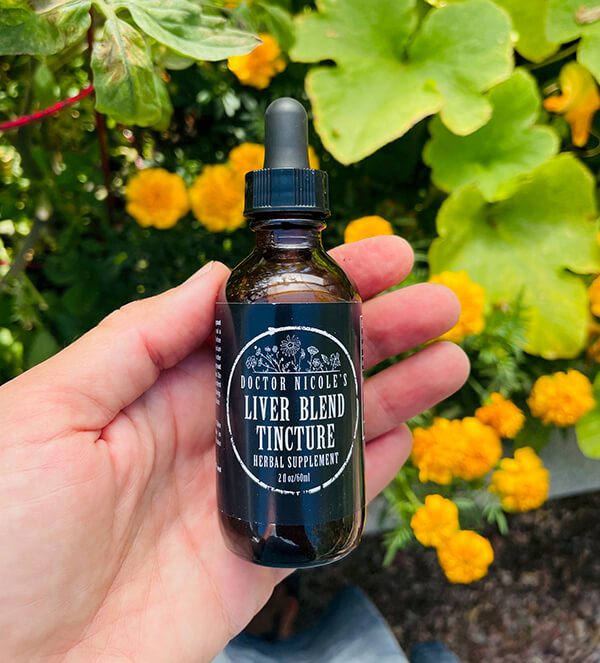
If you're looking to support your liver and kidneys, Nicole's Apothecary Liver Blend is an outstanding choice.
Thoughtfully formulated with research-backed herbs, this blend is designed to help flush toxins like PFAS, reduce inflammation, and restore optimal liver and kidney function.
Dandelion root, milk thistle seed, and schisandra berries are time-tested botanicals that work in synergy to support whole-body health.
The Takeaway
As we have seen, PFAS are a pervasive environmental toxin that can lead to a host of health challenges such as obesity, autoimmunity, liver damage, elevated cholesterol — and now gut inflammation, increasing the risk of developing ulcerative colitis, Crohn's disease, and colorectal cancer from early childhood exposure. Considering 45% of US tap water is contaminated with PFAS and 97% of Americans have accumulated it in their blood, it's crucial to avoid additional exposure via cookware, waterproof and stain resistant fabrics, and unfiltered water. Keeping your detoxification channels healthy and efficient should be a top priority as well — our powerfully effective Liver Blend can help. Stop by Nicole's Apothecary to learn more about this formulation and many other potent extracts to support your health.
Nicole Apelian
Actions Steps & FAQs
Action Steps
- Prioritize dietary balance rather than eliminating entire food groups or nutrients.
- Include fiber-rich whole foods to support a diverse, thriving gut microbiome.
- Add fermented foods to help maintain healthy levels of beneficial bacteria.
- Maintain consistent meal timing to support glucose regulation and metabolism.
- Consider an extra level of support with Nicole's Apothecary Balanced Gut Blend and Liver Blend.
FAQ
Does eliminating all sugar improve gut health?
Not necessarily. New research found that completely removing sucrose from a low-fat diet disrupted the gut microbiome, reducing beneficial bacteria like Lactobacillus murinus and increasing pro-inflammatory bacteria.
Can a zero-sugar or carnivore diet raise diabetes risk?
The study found that a sucrose-free diet led to impaired glucose control and reduced insulin sensitivity — both risk factors for type II diabetes — despite eliminating sugar entirely.
Is there a link between zero-sugar diets and fatty liver disease?
Yes. Researchers observed early warning signs of fatty liver disease and liver inflammation in the group following a completely sucrose-free diet.
Is balanced nutrition better than eliminating sugar completely?
According to the research, yes. Experts note that healthy eating depends on overall dietary patterns rather than eliminating a single nutrient or food group.
Nicole's Apothecary Products in this Post
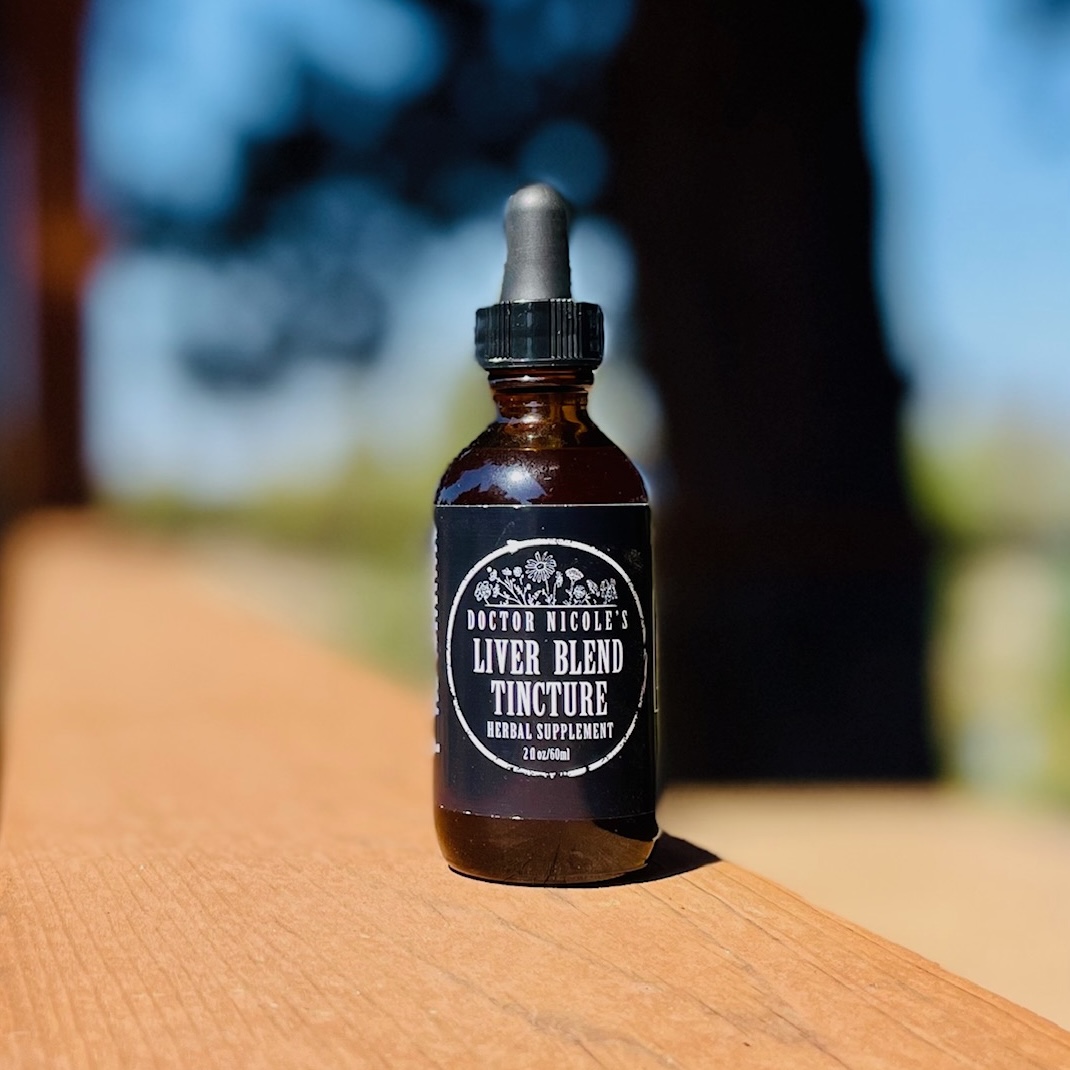
Liver Blend Tincture
References
- Midya, Vishal et al. “Per- and Polyfluoroalkyl Substances in Early Life Are Associated With Childhood Intestinal Inflammation: Analyses of Three Birth Cohorts.” Clinical gastroenterology and hepatology: the official clinical practice journal of the American Gastroenterological Association, S1542-3565(26)00513-6. 10 Jul. 2026, doi:10.1016/j.cgh.2026.07.001.
https://www.sciencedirect.com/science/article/abs/pii/S1542356526005136 - Ruyle BJ, Pennoyer EH, Vojta S, et al. High organofluorine concentrations in municipal wastewater affect downstream drinking water supplies for millions of Americans. Proc Natl Acad Sci USA. 2025;122(3):e2417156122. doi:10.1073/pnas.2417156122. https://www.pnas.org/doi/10.1073/pnas.2417156122
- Smalling KL, Romanok KM, Bradley PM, et al. Per- and polyfluoroalkyl substances (Pfas) in United States tapwater: comparison of underserved private-well and public-supply exposures and associated health implications. Environ Int. 2023;178:108033. doi:10.1016/j.envint.2023.108033. https://www.sciencedirect.com/science/article/pii/S0160412023003069?via%3Dihub
- Costello, Elizabeth et al. “Exposure to per- and Polyfluoroalkyl Substances and Markers of Liver Injury: A Systematic Review and Meta-Analysis.” Environmental health perspectives vol. 130,4 (2022): 46001. doi:10.1289/EHP10092. https://pubmed.ncbi.nlm.nih.gov/35475652/
- Li S, Oliva P, Zhang L, et al. Associations between per-and polyfluoroalkyl substances (PFAS) and county-level cancer incidence between 2016 and 2021 and incident cancer burden attributable to PFAS in drinking water in the United States. J Expo Sci Environ Epidemiol. Published online January 9, 2025. doi:10.1038/s41370-024-00742-2. https://www.nature.com/articles/s41370-024-00742-2
- How PFAS Impacts Your Health, Agency for Toxic Substances and Disease Registry, July 22, 2025. https://www.atsdr.cdc.gov/pfas/about/health-effects.html
- ‘Forever chemicals’ linked to gut inflammation in children after early exposure, by Tom Perkins, The Guardian, July 24, 2026. https://www.theguardian.com/environment/2026/jul/24/pfas-child-gut-inflammation
- Perfluoroalkyl and Polyfluoroalkyl Substances (PFAS), National Institute of Environmental Health Sciences. https://www.niehs.nih.gov/health/topics/agents/pfc
- Schlezinger, J.J., Bello, A., Mangano, K.M. et al. Per- and poly-fluoroalkyl substances (PFAS) in circulation in a Canadian population: their association with serum-liver enzyme biomarkers and piloting a novel method to reduce serum-PFAS. Environ Health 24, 10 (2025). https://doi.org/10.1186/s12940-025-01165-8
- Shearer JJ, Callahan CL, Calafat AM, et al. Serum concentrations of per- and polyfluoroalkyl substances and risk of renal cell carcinoma. J Natl Cancer Inst. 2021;113(5):580-587. doi:10.1093/jnci/djaa143. https://pubmed.ncbi.nlm.nih.gov/32944748/